BaleBio, construction phase, 2024 © Bas Princen
All articles
BaleBio: An Award-Winning Milestone for Bamboo
Date
16/1/2026
Read time
0
minutes
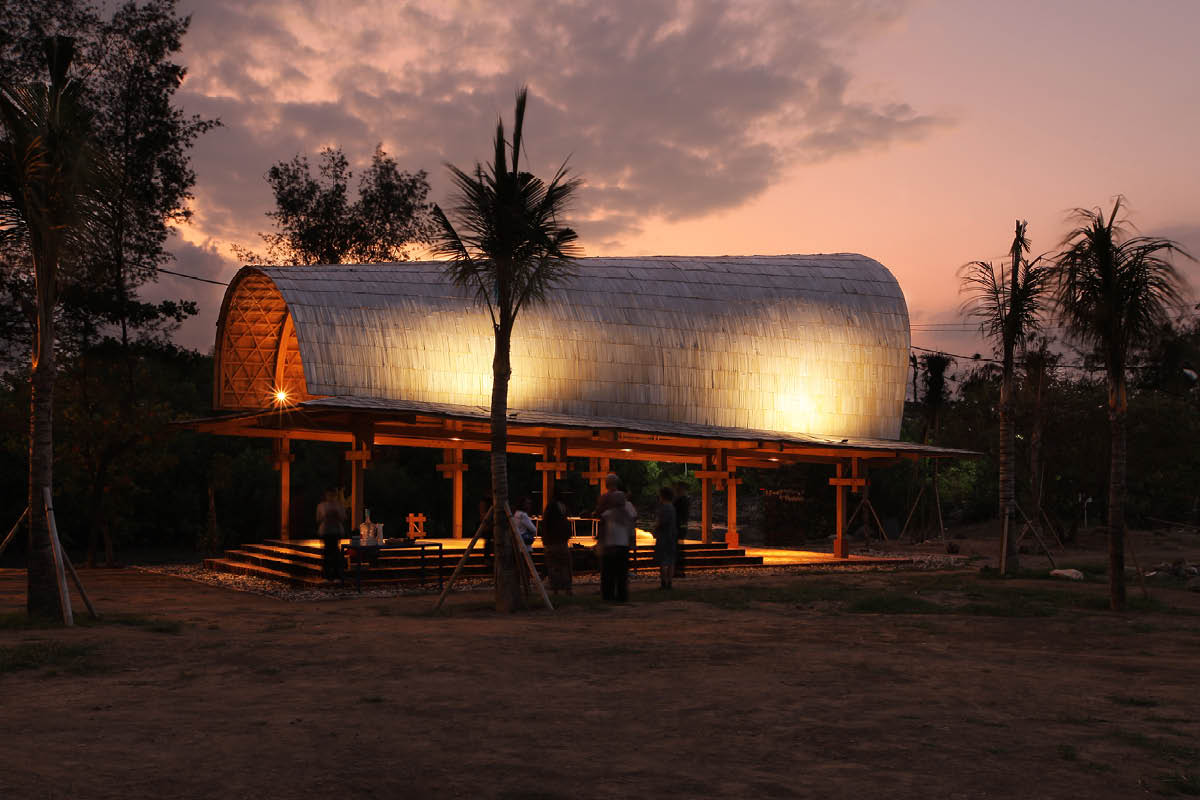
Developed as part of Bauhaus Earth's ReBuilt initiative and together with Bamboo Village Trust and Kota Kita, the BaleBio Pavilion marks a milestone in regenerative building. The 84-square-metre structure unites material innovation, craftsmanship, and community. Small in scale yet bold in vision, BaleBio challenges the extractive model of Bali's heavy concrete development and overtourism.

BaleBio on Mertasari Beach, Denpasar © Iwan Sastrawan
-web-(c)-414films.jpg)
BaleBio © Iwan Sastrawan; © Muhammad Zianurrahman


No items found.
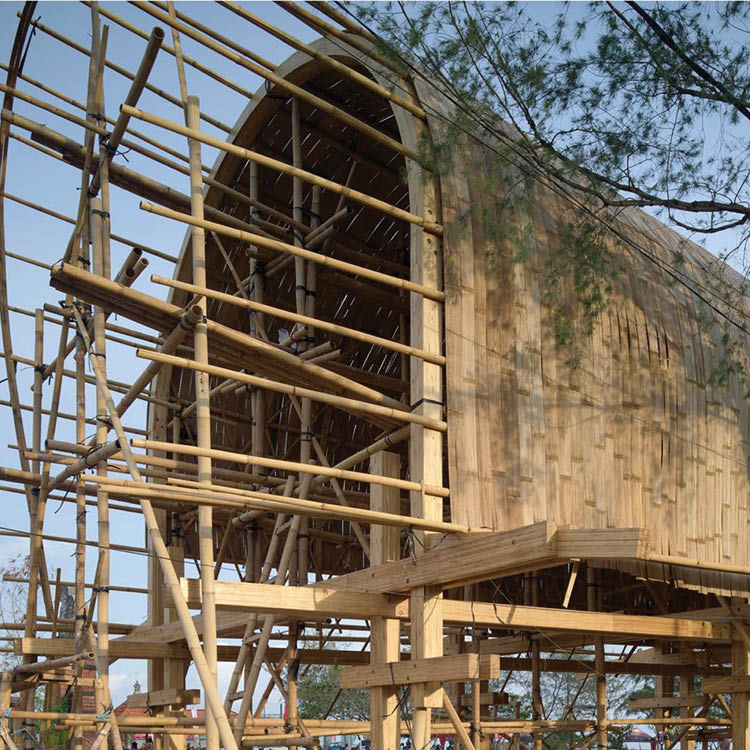
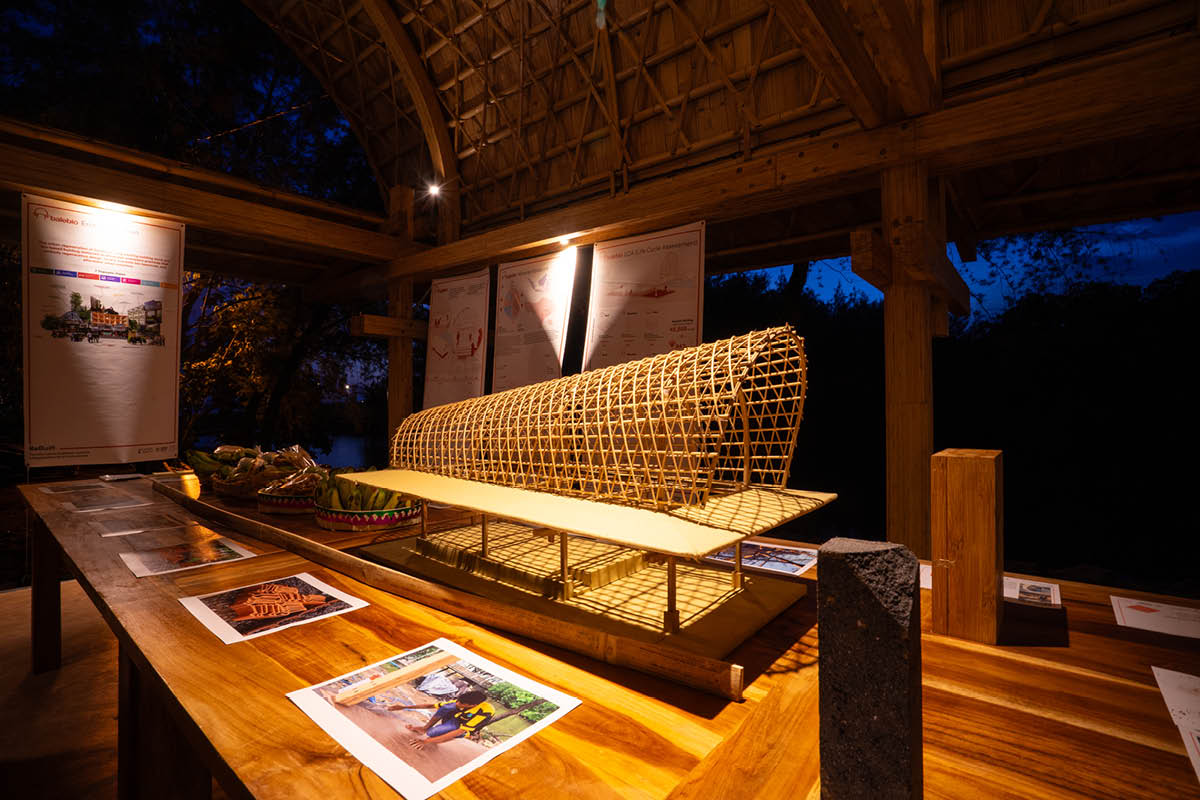
BaleBio, Construction Phase, 2024 © Bas Princen
Transforming bamboo
A sweeping barrel-vaulted roof of slender bamboo rafters, clad in pelupuh (flattened bamboo), rises 8.5 metres to form a striking canopy that provides shade, natural ventilation, and passive cooling. It is carried by a structure that embodies the building’s core innovation: transforming bamboo from a traditional round-pole material into a contemporary, high-performance engineered product.
The main frame uses locally sourced petung bamboo, compressed and resin-laminated to achieve the strength and versatility of steel or timber while retaining its renewability. All components are grown, processed, and assembled in Indonesia, establishing a regenerative regional supply chain. Construction combines traditional joinery with precision-engineered connections. Reclaimed volcanic rock, lime plaster, and repurposed clay roof tiles add thermal mass, and further reduce embodied carbon.
Saving carbon
A comprehensive value chain analysis assessed the circular potential and scalability of every material. Meanwhile, a rigorous Life Cycle Assessment confirmed BaleBio to be verifiably carbon-negative from Cradle to Construction (Stage A). It achieves a 110% reduction in embodied carbon compared with a conventional build, both avoiding more than 53 tonnes of CO₂ emissions (equivalent to planting over 2,400 trees) and actively absorbing carbon through its nature-based materials.
Beyond its environmental impact, BaleBio has transformed a once-neglected site previously earmarked for a car park into a vibrant public anchor. Since its completion in early 2025, it has become a popular meeting place, classroom, and stage for community events.
Awards
For its material, social, and architectural innovation, BaleBio received three major international awards: Gold in Excellent Architecture at the German Design Award 2026 in both Circular Design and Fair & Exhibition categories, the Australian Good Design Award for Social Impact 2025, and a commendation from the Built by Nature Prize 2025.
Credits:
Concept: Bauhaus Earth
Project Partners: Bamboo Village Trust, Kota Kita
Design: Cave Urban
Structural Engineering: Atelier One
Project Management: Bamboo Village Trust
Community Engagement: Kota Kita, Warmadewa University
LCA Analysis: Eco Mantra
Manufacturing: Indobamboo (Laminate Bamboo), KalTimber, Bhoomi, Bamboo Pure, Wedoo, Rothoblaas
Funded by the Federal Ministry for the Environment, Climate Action, Nature Conservation and Nuclear Safety (BMUKN)
Press Gallery
Partners