alexanderpaulbrandes_HEADER.jpg)
© Alexander Paul Brandes
Platten-Bau
Germany faces a structural housing paradox: nearly two million housing units sit vacant across the country, while major cities confront a housing deficit of equal proportion. Platten-Bau addresses this mismatch by treating vacant housing stock as a material reservoir for sustainable urban growth. Rather than resorting to carbon-intensive demolition and new construction, the project investigates how salvaged prefabricated reinforced concrete elements – specifically the ubiquitous East German WBS 70 series – can be relocated and reintegrated into expanding urban contexts.
Building upon the "Einfamilienhaus-Haus" pilot project by undjurekbrüggen and AFEA, the research maps regional salvage sites while conducting deconstruction, structural, and transport analyses. The fellows synthesise these findings into a practical manual for reassembling modular components into flexible, contemporary configurations. To ensure constructive feasibility, the project develops typified connection details using bio-based materials aligned with Germany’s simplified Gebäudetyp E building standards.
The research culminates in the construction of a 1:1 physical pavilion prototype alongside a comprehensive Life Cycle Assessment (LCA) to quantify net carbon savings. By demonstrating that internalising ecological external costs makes component reuse economically viable, Platten-Bau presents a scalable, regenerative alternative to the "demolish-and-crush" dogma dominant in contemporary construction.
alexanderpaulbrandes_SIDE.jpg)
© Alexander Paul Brandes
DavidHiepler_primary.jpg)
© David Hiepler
Jurek Brüggen & AFEA Association
Jurek Brüggen is an architect and founder of the Berlin- and Werben-based office undjurekbrüggen, as well as co-founder of AFEA alongside Aimée Michelfelder. His practice develops strategies that treat architecture as an active agent for ecological regeneration and building stock transformation. Brüggen studied architecture at ETH Zurich, served as a visiting professor at KIT Karlsruhe, was a 2025 fellow at the German Academy Rome Casa Baldi, and holds the 2026/27 Design Lectureship (Dozentur Entwerfen) at RWTH Aachen.
AFEA (Association for Ecological Architecture) is a non-profit organisation dedicated to redefining the role of architecture in creating sustainable, biodiverse communities through proposals addressing contemporary social and political challenges.
Patrick Holzer is a freelance architect specializing in sustainable transformation and circular construction. He graduated from ETH Zurich in 2022 with a Master’s thesis under Prof. Jan de Vylder. Following his graduation, he worked as a project and construction manager at the Berlin-based collective OFEA until 2024. In the same year, Patrick founded his own practice, where he develops and leads projects through diverse collaborative constellations. Since 2026, he has been a member of the Association for Ecological Architecture. Alongside his practice, he teaches as a Studio Tutor at the Berlin University of the Arts (UdK) under the chair of Prof. Götz.
Caterina Ricci, born and raised in Milan, obtained a BSc from Politecnico di Milano. She continued her studies in Berlin, completing an MSc in Architecture Typology at TU Berlin with a thesis investigating the relationship between architecture and reproductive labour. She was part of the team awarded the Sonderpreis "Soziale Stadtentwicklung" at the 2026 AIV-Schinkel-Wettbewerb and also co-authored one of the selected winning entries for the *DEMOT counter-competition. Caterina Ricci has been working at Undjurekbrüggen since 2024.
alexanderpaulbrandes_GALLERYSIDE.jpg)
© Alexander Paul Brandes
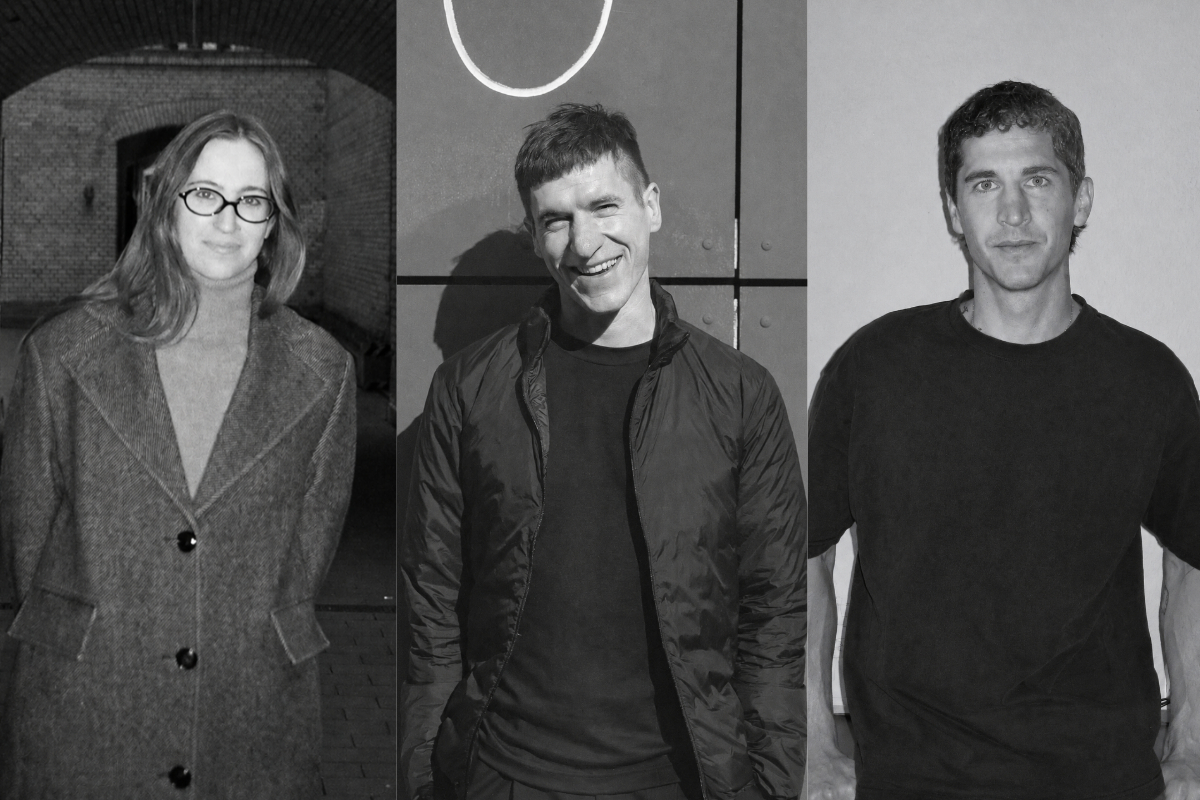
Caterina Ricci, Jurek Brüggen and Patrick Holzer. Second image © David Hiepler
DavidHiepler_GALLERY1.jpg)
No items found.
Resources
No items found.
Team
No items found.
No items found.
Bauhaus Earth Alumni
No items found.
Funders & Donors
No items found.
Partners
No items found.